Ultradian Rhythms: Why Your Brain Works in 90-Minute Cycles
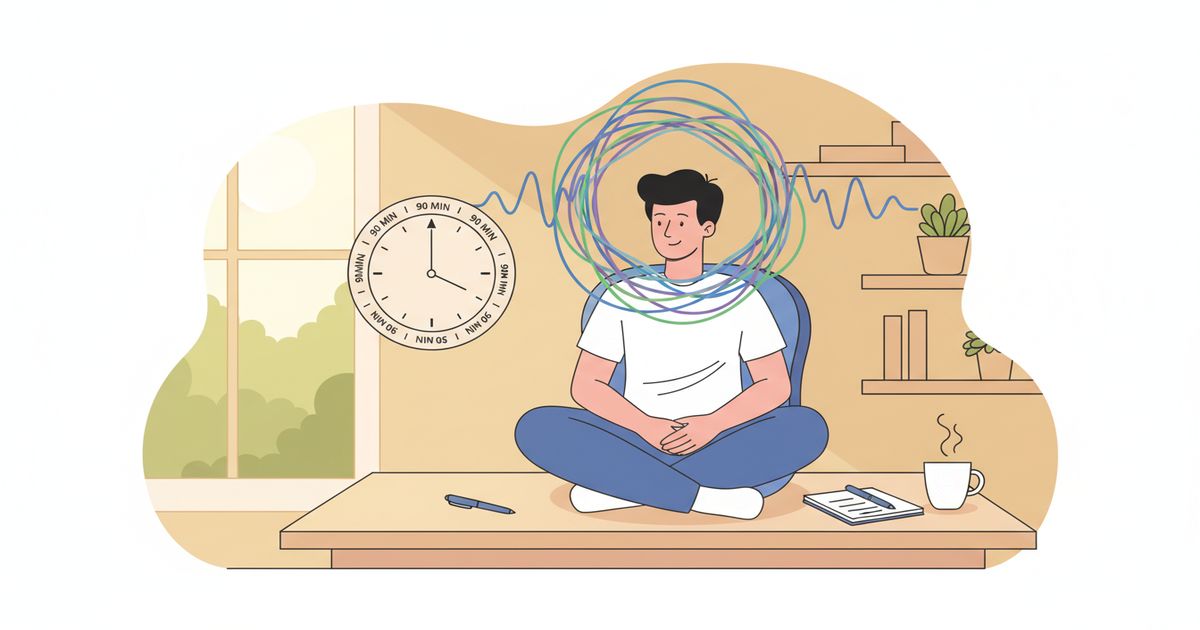
You sit down to write at 9 AM. The words flow. You're sharp, quick, making connections you didn't see yesterday. By 10:15, the sentences start coming slower. By 10:30, you're reading the same paragraph three times without absorbing it. You grab a coffee, push through for another twenty minutes, and produce work you'll probably delete tomorrow.
Then you take a break. Walk around. Come back at 11 AM. And suddenly the clarity returns. Not because the coffee kicked in - it would have hit 30 minutes ago. Because your brain just completed a biological cycle it runs whether you notice it or not.
That cycle has a name: an ultradian rhythm. And once you understand how it works, the way you structure your workday changes completely.
What Ultradian Rhythms Are (and Why You've Never Heard of Them)
Most people know about circadian rhythms - the 24-hour internal clock that tells your body when to sleep and when to wake up. But nested inside that daily cycle are shorter rhythms that repeat every 90 to 120 minutes. These are ultradian rhythms, and they govern far more of your daily experience than you probably realize.
The term comes from the Latin "ultra" (beyond) and "dies" (day) - literally, cycles faster than once per day. Sleep researcher Nathaniel Kleitman first described them in the 1960s while studying how sleep stages cycle through the night. He noticed that the 90-minute pattern of REM and non-REM sleep didn't just stop when you woke up. It continued throughout the day, creating alternating waves of high alertness and lower cognitive function.
Kleitman called this the Basic Rest-Activity Cycle, or BRAC. During the active phase - roughly 90 minutes - your brain operates at higher capacity. You think more clearly, concentrate more easily, and process information faster. Then your brain shifts into the rest phase - about 20 minutes - where alertness drops, focus becomes harder, and your body starts sending signals to slow down. Yawning, restlessness, difficulty concentrating, craving a snack. Those aren't random. They're your ultradian rhythm telling you it's time for a break.
The reason most people haven't heard of ultradian rhythms is simple: we're trained to ignore them. Office culture expects steady, uninterrupted output from 9 to 5. Schools run classes back to back with minimal breaks. The message is "push through" when your body says "slow down." So we override the signal with caffeine and willpower, and then wonder why our afternoon work is so much worse than our morning work.
The Science Behind the 90-Minute Cycle
Kleitman's initial observations have been backed by decades of research across multiple fields. EEG studies show that brain wave patterns shift in roughly 90-minute intervals throughout the day. Hormonal measurements reveal that cortisol, growth hormone, and other alertness-related chemicals pulse in ultradian patterns. Performance testing consistently shows that cognitive tasks follow the same wave.
A key study by Peretz Lavie at the Technion-Israel Institute of Technology tracked subjects' alertness across the day using a sleep-wake protocol. He found reliable 90-minute oscillations in sleepiness and performance, confirming that the cycle isn't just a sleep phenomenon. It's a fundamental feature of how your nervous system operates.
The mechanism involves your autonomic nervous system alternating between sympathetic (active, alert, engaged) and parasympathetic (resting, recovering, consolidating) dominance. During the active phase, your sympathetic nervous system is driving - heart rate slightly elevated, attention sharpened, cognitive resources mobilized. During the rest phase, the parasympathetic system takes over - the body slows down, and the brain shifts toward maintenance and memory consolidation.
This isn't a flaw in your biology. It's a feature. Your brain can't sustain high-performance cognition indefinitely. The rest phase is when your brain processes and consolidates the information you absorbed during the active phase. Skip the rest, and that processing doesn't happen as effectively. The next active phase starts from a weaker baseline, and each subsequent cycle degrades further.
What This Means for Your Focus and Productivity
If your brain naturally cycles every 90 minutes, then the structure of your workday either works with that rhythm or against it. Most schedules work against it - and the cost is real.
When you push through the rest phase, you're not being disciplined. You're spending cognitive resources your brain is trying to replenish. The work you produce during a forced push through the trough is measurably worse. Studies on surgical errors, for example, show that mistakes cluster around time periods that align with ultradian troughs - not because surgeons get tired from the work itself, but because their brains hit a natural low point.
This explains a pattern most people recognize but can't explain: why you can do brilliant work for an hour and a half, then suddenly can't string a sentence together. It's not decision fatigue (though that stacks on top). It's not laziness. It's your ultradian cycle telling you the active phase is over.
The connection to energy management is direct. Your overall energy follows a circadian arc (higher in the morning, lower after lunch, partial recovery in late afternoon). Your ultradian rhythm rides on top of that arc like smaller waves on an ocean swell. Even during your morning peak, you'll still experience 90-minute fluctuations. But those fluctuations are gentler during your peak hours and more pronounced when your circadian rhythm is already in a trough.
This is also why deep work sessions that last exactly 90 minutes feel so natural. Cal Newport's recommendation of 60-90 minute deep work blocks isn't arbitrary - it maps almost perfectly onto a single ultradian cycle. You're doing your most demanding thinking during the active phase and stopping before the rest phase drags your output quality down.
How to Identify Your Personal Ultradian Rhythm
The 90-minute average is just that - an average. Your personal cycle might be 80 minutes or 110 minutes. It might shift depending on how well you slept, what you ate, or how much stress you're carrying. The good news is that your body gives you clear signals if you learn to notice them.
Signs your active phase is ending:
- Sudden difficulty concentrating, even on something you were engaged in minutes ago
- Yawning or sighing (your body's attempt to shift your nervous system)
- Restlessness - fidgeting, stretching, wanting to stand up
- Hunger or thirst that wasn't there 20 minutes ago
- Mind wandering to unrelated topics despite trying to stay focused
- Re-reading text without retaining it
- A vague desire to check your phone or switch to something easier
Most people interpret these signals as personal failures - lack of discipline, poor attention span, not enough motivation. They're not. They're biological cues from a system that's been running for millions of years. The difference between someone who works with their ultradian rhythm and someone who fights it isn't willpower. It's awareness.
To map your personal cycle, try this for three days: every 30 minutes, jot down a simple 1-5 rating for how focused you feel. Don't change your routine - just observe. After three days, you'll likely see a pattern. Most people discover that their peaks and valleys follow a surprisingly regular cadence. That cadence is your ultradian rhythm.
The 90-Minute Work Block: How to Structure Your Day
Once you know your cycle, the structure is straightforward: work in focused blocks that match your active phase, then take real breaks during the rest phase. Here's what that looks like in practice.
The Active Phase (~90 minutes)
This is your window for demanding cognitive work. Writing, coding, strategic planning, creative problem-solving, complex analysis - anything that requires your brain's full resources. During this phase:
- Protect it fiercely. No email, no Slack, no phone. These context switches break the active phase and waste the cognitive resources your brain allocated for deep work.
- Start with a clear task. Decide what you'll work on before the block starts so you don't burn active-phase energy on planning. A daily planner helps here.
- Use a timer. The Pomodoro Technique fits naturally inside ultradian cycles. Two Pomodoro sessions (25 minutes each with a 5-minute break) take 55 minutes, and three take 90 minutes - right at the cycle boundary. Start a session to keep yourself on track.
- Don't extend it. When you feel the focus fading, stop. Pushing past the natural endpoint doesn't produce good work and makes the next cycle start from a deficit.
The Rest Phase (~20 minutes)
This is not optional downtime. It's the period where your brain consolidates what it just processed and prepares for the next active cycle. Skipping it is like skipping sleep - you can do it, but performance degrades fast.
Effective rest-phase activities:
- Walk. Movement without cognitive demand is ideal. Your brain processes in the background while your body resets.
- Eat a small snack. Your brain consumes about 20% of your total energy. Refueling during the rest phase supports the next cycle.
- Zone out. Stare out a window. Let your mind wander. This activates the default mode network, which handles creative connections and memory consolidation.
- Stretch or do light movement. Release the physical tension that accumulates during focused work.
What not to do during the rest phase: check email, scroll social media, read the news, or switch to "lighter" work tasks. These all demand cognitive resources and prevent the parasympathetic recovery your brain needs. The research on why breaks boost productivity is clear - a break only works if it's actually a break.
Ultradian Rhythms and the Pomodoro Technique
If you already use the Pomodoro Technique, you're already working partially in sync with your ultradian rhythm - you might not have realized why it feels so natural.
The standard Pomodoro structure is four 25-minute sessions with 5-minute breaks, followed by a longer 15-30 minute break. That full set of four Pomodoros takes roughly 2 hours - close to the length of one full ultradian cycle including the rest phase. The short breaks within the cycle provide micro-recovery, and the long break at the end aligns with the ultradian trough.
You can fine-tune the Pomodoro approach to fit ultradian rhythms more precisely. Some people find that three Pomodoros (about 90 minutes total) followed by a 20-minute break maps better onto their natural cycle than the traditional four. Others use a single 90-minute focused block without the intermediate 5-minute breaks, relying on the full ultradian rest phase for recovery. Experiment and see what your body responds to.
The key insight is that both systems point to the same truth: time-bounded work sessions followed by genuine rest produce better results than continuous, unstructured work. Whether you call it Pomodoro or ultradian-based scheduling, you're working with your biology instead of against it.
A Sample Ultradian Workday
Here's what a day structured around ultradian rhythms looks like. Adjust the timing based on when you wake up and your personal cycle length.
7:00 - 8:30 AM — First cycle: Deep work. Your first ultradian cycle after waking is typically your strongest. Use it for your hardest, most creative work. This is eat-the-frog territory - tackle the task you've been avoiding or the project that requires your sharpest thinking.
8:30 - 9:00 AM — Rest phase. Walk, eat breakfast, make coffee. Do not check email yet.
9:00 - 10:30 AM — Second cycle: Focused work. Still in your circadian peak. Good for complex collaboration, writing, analysis, or any work that demands sustained attention. Use the Pomodoro timer for structure.
10:30 - 11:00 AM — Rest phase. Move, stretch, hydrate. Let your brain consolidate.
11:00 AM - 12:30 PM — Third cycle: Communication and decisions. Your circadian alertness is starting to ease. This is a good slot for meetings, email batching, phone calls, and collaborative work that doesn't demand peak creativity.
12:30 - 1:30 PM — Extended break. Lunch. The post-lunch dip in circadian rhythm combines with an ultradian trough. Don't fight it. A proper break here - especially one with movement - sets up a stronger afternoon.
1:30 - 3:00 PM — Fourth cycle: Moderate cognitive work. You're past the post-lunch dip but not at peak alertness. Good for editing, reviewing, organizing, planning tomorrow's time blocks, or tasks that require attention but not breakthrough thinking.
3:00 - 3:20 PM — Rest phase. The circadian "second wind" is approaching. A real break now amplifies it.
3:20 - 4:50 PM — Fifth cycle: Afternoon focus. Many people experience a secondary alertness peak in late afternoon. Some find this is actually a good creative window. Use it for whatever matches your energy level.
4:50 - 5:00 PM — Wind down. Review what you accomplished. Plan tomorrow using the Eisenhower Matrix to prioritize. Close out the day.
Notice the pattern: roughly five 90-minute work cycles with 20-30 minute breaks between them. That's about 7.5 hours of active work and 2 hours of rest - in an 8-to-5 workday. You're not working less. You're working smarter by not spending time in the trough producing subpar output.
Common Mistakes When Working With Ultradian Rhythms
Treating the rest phase as "wasted time." This is the biggest one. People understand the concept intellectually but feel guilty resting every 90 minutes. Remember: the rest phase is productive. Your brain is actively processing, consolidating, and preparing. Without it, the next active phase is weaker. You're not losing 20 minutes. You're investing them in the next 90.
Using caffeine to power through troughs. Coffee masks the symptoms of the rest phase without providing the actual recovery. You feel alert, but your brain hasn't consolidated or recharged. The result is a jittery simulation of productivity that produces worse work than if you'd just taken the break. Strategic caffeine timing - drinking it at the start of an active phase, not during a trough - works much better.
Expecting mechanical precision. Your ultradian cycle isn't a metronome. It's more like a general rhythm that varies with sleep quality, stress, nutrition, and what you're working on. Some days you'll get a strong 100-minute active phase; other days it might be 70 minutes. Listen to the signals rather than watching the clock.
Scheduling meetings during your best cycles. If your first morning cycle is your sharpest, don't spend it in a status meeting. Protect your peak ultradian cycles for the work that actually requires peak cognition. Procrastination often happens when important tasks get pushed to weaker cycles.
Filling the rest phase with "lighter" work. Answering emails, organizing files, or reviewing documents during your rest phase defeats the purpose. These activities demand cognitive resources. The rest phase needs to be genuinely restful to do its job.
How Sleep Quality Affects Your Ultradian Rhythms
Your daytime ultradian rhythms are directly connected to your sleep ultradian rhythms. During sleep, you cycle through REM and non-REM stages in roughly 90-minute intervals. If your sleep is disrupted - not enough total hours, frequent waking, poor sleep architecture - your daytime cycles become irregular and weaker.
This is why a bad night's sleep doesn't just make you tired. It disrupts the rhythm that structures your entire waking day. Your active phases become shorter, your rest phases bleed into active time, and the contrast between peak and trough diminishes. You might feel a flat, low-grade fog all day instead of the clear peaks and valleys that characterize a well-rested ultradian cycle.
Good sleep hygiene, then, isn't just about feeling rested. It's about maintaining the biological infrastructure that makes focused work possible during the day. This is one more reason why a consistent morning routine matters - a regular wake time helps stabilize your ultradian cycles throughout the day.
Ultradian Rhythms for Different Work Styles
For remote workers: You have an advantage. Without the interruption structure of an office, you can align your schedule directly with your ultradian rhythm. The risk is the opposite problem - without external structure, it's easy to ignore the rest phase and work straight through. Set actual timers for your breaks. Remote work productivity improves when you add structure, not remove it.
For students: Study sessions that last exactly 90 minutes with 20-minute breaks between them will feel more effective than four-hour marathon sessions. Your brain literally cannot sustain high-quality learning for four consecutive hours. The Pomodoro study method works because it naturally fits within ultradian timing. Two or three Pomodoro sessions per study block, with a real break between blocks.
For managers and leaders: Your day is often dictated by other people's schedules - meetings, one-on-ones, all-hands. Protect at least one morning ultradian cycle for your own thinking work. Block it on your calendar. The strategic decisions and creative thinking that leadership requires deserve your best cognitive resources, not whatever's left after back-to-back meetings.
For creative professionals: Many artists, writers, and designers report that their best work comes in 90-minute bursts without realizing they're describing ultradian active phases. If you've ever experienced flow state, it likely lasted around 90 minutes before naturally fading. That's not coincidence. Flow and the ultradian active phase are closely related, and both benefit from a recovery period afterward.
Frequently Asked Questions
Can I train myself to have longer ultradian cycles?
Not really. Ultradian rhythms are deeply embedded biological patterns, not habits you can reshape through practice. What you can do is optimize conditions so your active phases are as productive as possible. Good sleep, proper nutrition, regular exercise, and minimizing distractions during active phases all help you get more from each cycle. But trying to extend the cycle itself is like trying to make your heart beat slower through sheer willpower - the mechanism isn't under conscious control.
Do ultradian rhythms explain why I crash after lunch?
Partly. The post-lunch dip is primarily a circadian phenomenon - your 24-hour clock naturally dips in early afternoon regardless of whether you eat. But an ultradian trough landing at the same time as the circadian dip creates a double whammy. This is why the period from about 1:00 to 2:30 PM feels especially unproductive for most people. The solution isn't to fight through it. Take a proper break, eat a balanced meal, and schedule your least demanding work for that window.
What if my job doesn't allow 20-minute breaks every 90 minutes?
Few jobs explicitly allow it, but most jobs have more flexibility than you think. Even a 5-minute walk to refill your water bottle or a 3-minute stretch at your desk provides some parasympathetic recovery. The key is to stop demanding peak cognitive output from yourself during the trough, even if you can't fully step away. Shift to low-demand tasks for 15 minutes - filing, organizing, routine correspondence - and you'll still capture most of the benefit. The worst thing you can do is schedule a high-stakes meeting or creative task during your trough.
How do ultradian rhythms interact with caffeine?
Caffeine blocks adenosine receptors, which suppresses the sleepiness signal but doesn't actually restore the cognitive resources that deplete during an active phase. Drinking coffee during an ultradian trough can make you feel awake without actually sharpening your thinking. The better strategy is to time caffeine at the start of an active phase - it takes about 20-30 minutes to reach peak effect, so drinking coffee at the beginning of a work block means it's fully active right when you need it. Avoid caffeine during the rest phase, as it interferes with the parasympathetic recovery your brain needs.
Are ultradian rhythms the same for night owls and early birds?
The ultradian cycle length is similar regardless of chronotype - both early birds and night owls experience roughly 90-minute cycles. What differs is when the strongest cycles occur. Early birds tend to have their most potent active phases in the morning, while night owls may find their sharpest cycles in late morning or afternoon. Knowing your chronotype helps you identify which ultradian cycles to protect for your most important work. The rhythm itself is universal; the timing of your best cycles is individual.