Context Switching: Why Multitasking Kills Your Productivity
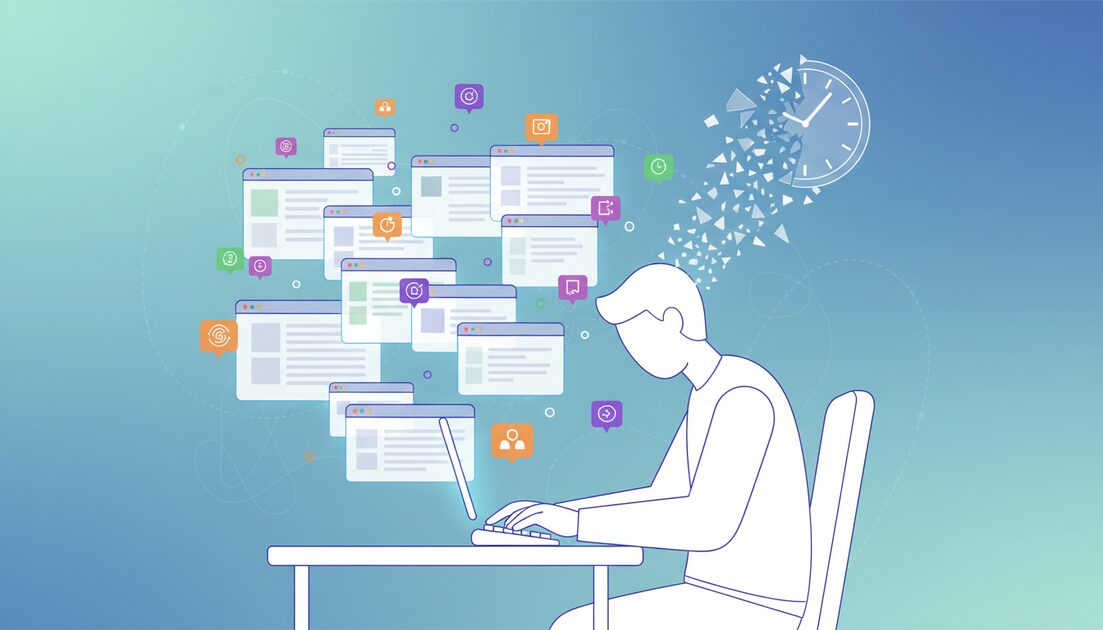
You sit down to write a report. Five minutes in, a Slack message pops up. You glance at it — just a quick check — and type a three-word reply. You go back to the report. Where were you? You re-read the last paragraph. Another notification. An email this time. You scan it, decide it can wait, and return to the report. Except now you have lost your train of thought completely. You stare at the screen for a minute, trying to remember the point you were about to make.
That entire sequence took maybe four minutes. But the damage to your focus will linger for another 20. Welcome to context switching - the silent productivity killer that most people never even notice.
What Context Switching Actually Is
Context switching happens every time you shift your attention from one task to a different one. It does not matter whether the shift is voluntary (you decided to check Twitter) or involuntary (your phone buzzed). The effect on your brain is the same.
When you are working on a task, your brain builds a mental model of it. You hold relevant information in working memory - the structure of your argument, the variable names in your code, the client's requirements, the sentence you were about to write. This mental model is fragile. It took time to build, and it collapses almost instantly when your attention moves elsewhere.
Switching to a new task means your brain has to dismantle the current model and construct a new one. Then when you switch back, it has to rebuild the original model from scratch. Each of these transitions costs time and cognitive energy. The more complex the task, the higher the cost.
Computer scientists borrowed the term from operating systems, where context switching refers to the overhead of saving one process's state and loading another's. Your brain works the same way. And just like with computers, the switching itself is pure overhead - it produces nothing.
The Real Cost: 23 Minutes Per Interruption
Gloria Mark, a professor at UC Irvine, ran a study that tracked knowledge workers throughout their day. She found something startling: after being interrupted, it takes an average of 23 minutes and 15 seconds to get back to the original task. Not to reach peak focus - just to return to the task at all.
Think about what that means. If you get interrupted four times in a morning, you have lost over 90 minutes just on recovery time. That is not counting the time spent on the interruptions themselves. A three-hour morning with four interruptions might produce less than an hour of actual focused work.
The American Psychological Association puts it more broadly: task switching can consume up to 40% of someone's productive time. If you work an eight-hour day, that is over three hours gone - not to breaks or meetings, but to the invisible tax of switching between tasks.
And the quality suffers too. A 2001 study by Joshua Rubinstein, David Meyer, and Jeffrey Evans found that people made more errors when switching between tasks compared to completing them sequentially. The errors increased with task complexity. Simple tasks had a small switching cost. Complex, cognitively demanding work - the kind that actually moves your career forward - carried the steepest penalty.
Why Your Brain Cannot Truly Multitask
The idea that some people are good multitaskers is a myth. Neuroscience has been clear on this for decades. The human brain can only perform one attention-demanding cognitive task at a time. What feels like multitasking is actually rapid context switching - your brain bouncing between tasks so quickly that it creates the illusion of simultaneity.
You can walk and talk at the same time because walking is automated - it does not require conscious attention. But you cannot write an email and listen to a podcast with equal comprehension. One of them will get degraded attention. Usually both.
A Stanford study led by Clifford Nass found that people who identified as heavy multitaskers were actually worse at filtering irrelevant information, worse at switching between tasks, and worse at working memory than people who multitasked less. The very people who thought they were great at juggling multiple things were the ones paying the highest cognitive price.
This matters because modern work environments are designed to encourage constant switching. Open offices, always-on chat tools, email notifications, and the expectation of instant responses all conspire to fragment your attention into tiny, useless pieces.
The Five Types of Context Switches
Not all context switches are created equal. Understanding the different types helps you figure out which ones to eliminate first.
1. Notification interruptions. These are the most common. A phone buzz, a desktop notification, an email alert. Even if you do not act on the notification, just seeing it pulls a thread of attention away from your current task. Studies show that simply knowing your phone is nearby - even if it is silent and face down - reduces available cognitive capacity.
2. Self-interruptions. You are working on a spreadsheet and suddenly think "I should check if that package arrived." So you open a browser tab and check tracking. These voluntary switches feel harmless because you chose them, but they carry the same 23-minute recovery cost as external interruptions.
3. Task juggling. Working on three projects simultaneously, switching between them throughout the day. Each switch requires rebuilding the mental context of a different project - different stakeholders, different goals, different details to remember.
4. Meeting fragmentation. A meeting at 10:00, another at 11:30, another at 1:00. The meetings themselves are only 30-60 minutes, but they break your day into chunks too small for deep, focused work. You spend the gaps between meetings doing shallow tasks because you know another interruption is coming soon. The meeting cost calculator shows just how expensive this fragmentation really is when you factor in switching costs per attendee.
5. Tool switching. Jumping between applications - from your code editor to a browser to Slack to a spreadsheet to email and back. Each application represents a different mental context, and the physical act of switching between them triggers a cognitive switch too.
What Context Switching Does to Your Brain
The cost is not just lost time. Frequent context switching changes how your brain operates throughout the day.
Decision fatigue accelerates. Every switch requires a micro-decision: should I respond to this? Is this urgent? Can it wait? Those decisions drain the same mental resource you need for your actual work. By mid-afternoon, your ability to make good decisions is significantly degraded. This is the same phenomenon that makes you reach for junk food at 4 PM - your willpower tank is empty from a day of constant switching.
Stress hormones increase. Gloria Mark's research also measured heart rate variability and cortisol levels in frequently interrupted workers. The results showed elevated stress markers even when people reported feeling fine. Your body registers the cost of constant switching even when your conscious mind does not.
Creativity drops. Creative insights require sustained attention. Your brain needs uninterrupted time to make novel connections between ideas. In a state of constant switching, you default to familiar, well-worn thought patterns because there is not enough sustained focus to explore new territory. This is why your best ideas tend to come in the shower or on a walk - those are the rare moments when your attention is not being pulled in five directions.
Attention span shrinks over time. This is the most insidious effect. The more you practice context switching, the worse your sustained attention becomes. Your brain adapts to fragmentation. After months or years of constant switching, many people find they cannot focus on a single task for more than a few minutes even when they want to. The ability to do deep work atrophies like an unused muscle.
How to Stop the Switching Cycle
You cannot eliminate all context switches. Emergencies happen, collaboration requires communication, and some switching is just part of having a job. But you can dramatically reduce the unnecessary switches that eat most of your productive time.
1. Use a Pomodoro Timer to Create Focus Windows
The Pomodoro Technique is one of the most effective defenses against context switching. You commit to working on one task for 25 minutes. During that window, everything else waits. No messages, no email, no "quick checks." The timer creates a boundary that is surprisingly effective at keeping interruptions out.
When the 25 minutes end, you take a five-minute break. This is when you check messages, reply to that Slack ping, or deal with whatever came in during your focus window. The key insight is that most things can wait 25 minutes. Very few messages are genuinely urgent enough to justify derailing your focus mid-task.
Over time, the Pomodoro structure trains your brain to sustain attention for the full 25 minutes. The timer gives you a concrete endpoint, which makes it easier to resist the urge to check something "real quick." Try starting a Pomodoro session right now and notice how your impulse to switch fades once you commit to the timer.
2. Batch Similar Tasks Together
Task batching means grouping similar activities into a single block of time. Instead of answering emails throughout the day (a context switch every time), you answer them all at 9 AM and 3 PM. Instead of jumping between writing, coding, and meetings, you block your morning for creative work and your afternoon for communication.
Batching works because similar tasks use the same mental framework. Going from one email to another is not a real context switch - your brain stays in "communication mode." Going from an email to a coding problem is a full context switch that costs real cognitive overhead. Methods like Inbox Zero formalize this by limiting email to two or three scheduled processing sessions per day.
3. Block Your Calendar for Deep Work
Time blocking means scheduling specific hours for specific types of work. Block a two-hour window for your most important project. During that block, you are unavailable for meetings, calls, or chat. Treat it like an appointment that cannot be moved.
This solves the meeting fragmentation problem. Instead of letting meetings break your day into unusable scraps, you protect continuous blocks for work that requires deep focus. Most people find that two or three hours of protected deep work produces more than an entire day of fragmented effort.
4. Kill the Notifications
Turn off every notification that is not genuinely time-sensitive. That means Slack badges, email alerts, social media pings, news updates - all of them. Check these on your schedule, not theirs.
This feels radical at first. You might worry about missing something important. But here is the truth: in a typical workday, fewer than 5% of messages actually require a response within the hour. The other 95% are just noise that fragments your attention and gives you nothing in return.
If you are worried about emergencies, set up a single channel for urgent communication - a phone call or a specific chat channel that you keep unmuted. Everything else can wait until your next break.
5. Keep a Capture List
Half of self-interruptions come from random thoughts that feel urgent in the moment. "I need to buy groceries." "I should update that spreadsheet." "Did I reply to Sarah?" Instead of acting on these thoughts immediately (which means a context switch), write them on a capture list - a simple notebook or text file next to your workspace.
The act of writing it down tells your brain it will not be forgotten. That is usually enough to let the thought go so you can return to what you were doing. During your next Pomodoro break, scan the capture list and decide which items actually need attention.
6. Apply the Two-Minute Rule Strategically
The two-minute rule says that if a task takes less than two minutes, do it immediately rather than adding it to your list. But use this rule during transition periods - between Pomodoro sessions, between meetings, or at the start and end of your day. Do not use it as an excuse to break focus mid-task. During a focused work block, even two-minute tasks go on the capture list.
Context Switching for Different Types of Work
Software developers are among the hardest hit by context switching. A programmer building a complex function holds an intricate mental model of data structures, logic flows, and edge cases. One interruption can collapse that entire model. Studies specific to developers show it can take 15-30 minutes to rebuild the context for a complex coding task. This is why developers are so protective of uninterrupted blocks - and why Pomodoro sessions are popular in engineering teams.
Writers and content creators face a similar problem. Writing requires sustained access to your internal voice and the thread of your argument. Once that thread breaks, re-reading what you wrote is not enough - you need to reconstruct the emotional and intellectual state you were in when the words were flowing. Many writers find that a single interruption can end a productive writing session entirely.
Managers and team leads often have the most context switches of anyone. They bounce between one-on-ones, team standups, project reviews, and their own work throughout the day. The solution for managers is not to eliminate switching entirely - that is not realistic - but to cluster similar interactions together and protect at least one two-hour block per day for non-meeting work.
Students who study while checking social media are essentially guaranteeing poor retention. Every glance at a phone during study resets the encoding process in long-term memory. A two-hour study session with frequent phone checks will produce less learning than 45 minutes of phone-free focus.
Building a Low-Switch Day
Here is what a day designed to minimize context switching looks like:
7:00 - 7:30 AM: Morning routine. No phone, no email. Give your brain a clean start.
8:00 - 10:00 AM: Deep work block. Two hours on your single most important task. Notifications off. Use Pomodoro sessions (four 25-minute sprints with breaks) to maintain focus throughout.
10:00 - 10:30 AM: Communication batch. Check and respond to all messages, emails, and Slack. Deal with quick items using the two-minute rule.
10:30 - 12:00 PM: Second deep work block or collaborative work. If you have meetings, cluster them here.
12:00 - 1:00 PM: Lunch break. Actual break. Not eating while working.
1:00 - 3:00 PM: Afternoon deep work or batched tasks. Administrative work, reviews, planning.
3:00 - 3:30 PM: Second communication batch. Final email and message sweep.
3:30 - 5:00 PM: Wrap-up work. Lighter tasks, planning tomorrow, tying up loose ends.
Notice the pattern: communication is batched into two windows. Deep work gets protected blocks. The day has structure but is not rigid. This design means you switch contexts maybe 5-6 times per day instead of 50-60.
Measuring Your Context Switches
Before you can improve, you need to see the problem. For one day, keep a tally of every time you switch tasks. Every notification you check, every time you open a new app, every time someone taps your shoulder. Most people are shocked by the number. It is common to count 50-80 context switches in a single workday.
After tracking, use the Focus Session Log to record your deep work sessions and see how much uninterrupted focus time you actually get. Most people discover they are getting less than two hours of true focus per day - in an eight-hour workday. The gap between time spent at work and time spent doing focused work is almost entirely explained by context switching.
Then use the Weekly Productivity Review to track your progress over time. As you implement the strategies above, you should see your daily focus hours climb and your switch count drop.
Frequently Asked Questions
What is context switching?
Context switching is when you shift your attention from one task to another before finishing the first one. Every switch forces your brain to unload the mental state of the previous task and load the context of the new one. This cognitive overhead means you lose time, make more mistakes, and produce lower quality work. Even brief interruptions - checking a notification, answering a quick message - count as context switches because they pull your working memory away from the task at hand.
How much time does context switching waste?
Research from the American Psychological Association suggests that switching between tasks can cost up to 40% of your productive time. A study by Gloria Mark at UC Irvine found that after an interruption, it takes an average of 23 minutes and 15 seconds to fully return to the original task. Even if the interruption lasted 30 seconds, the recovery time stays roughly the same because your brain needs to reconstruct the full mental model of what you were doing.
Is multitasking the same as context switching?
They are closely related but not identical. Multitasking is the attempt to do two or more cognitive tasks at the same time. Context switching is what actually happens when you try - your brain rapidly alternates between tasks rather than truly processing them in parallel. Neuroscience research shows the human brain cannot perform two attention-demanding tasks simultaneously. What feels like multitasking is actually fast context switching, and each switch carries a cost.
How does the Pomodoro Technique help with context switching?
The Pomodoro Technique creates a protected 25-minute window where you commit to a single task. During that window, you ignore all other tasks, messages, and interruptions. This eliminates voluntary context switching entirely. The scheduled break after each Pomodoro gives you a natural point to check messages or switch tasks without the cognitive penalty of mid-task interruptions. Over time, this trains your brain to sustain focus for longer stretches.
How can I reduce context switching at work?
Start by batching similar tasks together so your brain stays in the same mode. Turn off non-essential notifications during focused work. Use time blocking to dedicate specific hours to specific types of work. Set expectations with coworkers about response times. Use a Pomodoro timer to create structured focus periods. And keep a capture list nearby so when random thoughts pop up, you can write them down and return to them later instead of acting on them immediately.