The Ivy Lee Method: The 100-Year-Old Productivity System That Still Works
In 1918, Charles Schwab was running Bethlehem Steel, one of the largest companies in America. He was already wealthy and successful, but he wanted his executives to get more done. So he hired a productivity consultant named Ivy Lee and gave him a challenge: show my team how to accomplish more in less time.
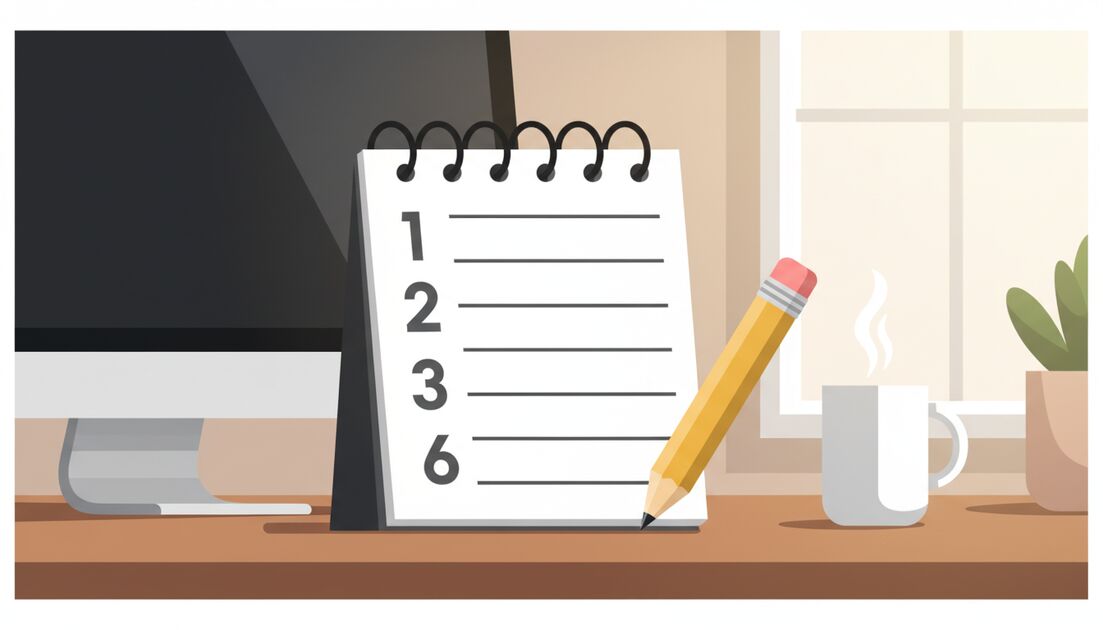
Lee asked for 15 minutes with each executive. He gave them one instruction: at the end of each workday, write down the six most important things you need to accomplish tomorrow. Number them in order of importance. When you arrive the next morning, start on task number one. Work on it until it is finished, then move to number two. Continue down the list. At the end of the day, move any unfinished items to the top of a new list of six for tomorrow. Repeat every working day.
Schwab asked what he owed for this advice. Lee told him to try it for three months and pay whatever he thought it was worth. Three months later, Schwab sent Lee a check for $25,000 - roughly $500,000 in today's money. He called it the most profitable advice he had ever received.
That story has been told thousands of times. But the interesting part is not the story itself. The interesting part is that more than a hundred years later, the method still works - and still outperforms most of the complex productivity systems people build around it.
The Five Steps of the Ivy Lee Method
The entire system takes about five minutes. Here is exactly what you do:
- At the end of your workday, write down the six most important tasks for tomorrow. Not seven. Not ten. Six. If you have fewer than six, that is fine. But never more.
- Rank them in order of true importance. Task number one is the thing that matters most. Not the most urgent, not the easiest, not the one your boss just mentioned - the one that would make the biggest difference if it got done.
- The next morning, start immediately on task number one. Do not check email first. Do not review your calendar. Do not scan the news. Go straight to the most important thing.
- Work on each task until it is complete before moving to the next. If you get stuck or blocked, give it a genuine effort before deciding to move on. The point is sustained focus, not bouncing between items.
- At the end of the day, move any unfinished tasks to the new list. Re-rank them alongside any new priorities. Start again tomorrow.
That is the whole method. No apps, no categories, no color-coded labels, no weekly reviews, no inbox processing workflows. Just a numbered list of six things and the discipline to work through them in order.
Why Six? The Psychology Behind the Constraint
The number six is not arbitrary. It sits right at the boundary of what cognitive science calls our working memory limit. George Miller's famous 1956 research suggested we can hold roughly seven items (plus or minus two) in working memory at once. More recent studies have revised that number downward to about four chunks for complex tasks.
Six tasks is enough to fill a productive day but few enough that your brain can hold the whole list without stress. Compare this to the typical to-do list, which might have 15 or 20 items. That kind of list creates what psychologists call decision fatigue - you burn mental energy just deciding what to work on next, before you have done any actual work.
The constraint also forces prioritization. If you can only pick six things, you have to leave items off the list. That is the hard part, and it is also the valuable part. Most people never explicitly decide what is not worth doing today. They just keep adding to the list and hope they will get to everything. The Ivy Lee Method makes the trade-off visible every single evening.
Single-Tasking: The Hidden Power of Working in Order
The rule about working on one task at a time, in order, is where most of the method's power comes from. It eliminates the constant context switching that destroys modern productivity.
Research from the American Psychological Association shows that switching between tasks can cost as much as 40% of your productive time. Every time you jump from one thing to another, your brain has to reload the context - where you were, what you were thinking about, what the next step was. That reload is not instant. It can take 15 to 25 minutes to fully re-engage with a complex task after an interruption.
The Ivy Lee Method prevents this by removing the decision entirely. You do not choose what to work on next. The list already told you. Task one, then task two, then task three. There is no moment where you pause, scan a list of 20 items, weigh priorities, and pick the most appealing one. You just keep moving forward.
This is the same principle behind monotasking and deep work - the idea that sustained attention on a single thing produces dramatically better results than scattered attention across many things. The Ivy Lee Method just builds that principle into a dead-simple daily ritual.
Why the Evening Planning Matters
Lee was specific about when to make the list: the end of the workday, not the beginning. That timing matters more than most people realize.
When you plan the night before, you arrive the next morning with a clear starting point. There is no "what should I do first?" debate. No 30-minute warm-up of checking email and shuffling papers while your brain slowly wakes up. You sit down and start. That immediate momentum compounds throughout the day.
Evening planning also takes advantage of a psychological phenomenon called the Zeigarnik effect. Unfinished tasks create a kind of mental tension - your subconscious keeps circling back to them. When you write tomorrow's tasks down before leaving work, you give your brain permission to let go. The list holds the information so you do not have to. You sleep better, and your subconscious actually works on the problems overnight.
Many people who try morning routines and daily planning do it at 8 AM, but by then they have already lost their freshest energy to the planning process itself. The Ivy Lee Method moves planning to the evening so that morning energy goes entirely into execution.
The Ivy Lee Method vs. Other Productivity Systems
The productivity world has produced dozens of systems since 1918. Here is how the Ivy Lee Method compares to some of the most popular ones.
Ivy Lee vs. Getting Things Done (GTD)
David Allen's Getting Things Done system is comprehensive. It involves capturing everything, clarifying next actions, organizing by context, reviewing weekly, and engaging with your lists based on energy and time. It works well for people who manage complex, multi-project workloads.
The Ivy Lee Method is the opposite of comprehensive. It does one thing: decide what is most important and do it first. If GTD is a full operating system, the Ivy Lee Method is a single command. Some people use both - GTD as the overall capture and organization system, and the Ivy Lee Method as the daily execution layer that pulls six items from their GTD lists each evening.
Ivy Lee vs. the Eisenhower Matrix
The Eisenhower Matrix sorts tasks into four quadrants based on urgency and importance. It is an excellent thinking tool for understanding what kind of work fills your days. But it does not tell you what to do first thing tomorrow morning. The Ivy Lee Method takes the output of Eisenhower-style thinking and turns it into a sequential action plan.
Ivy Lee vs. Eat the Frog
Brian Tracy's Eat the Frog principle says to do your hardest, most important task first each day. The Ivy Lee Method essentially bakes this in - task number one should be the thing that matters most, which is usually also the thing you are most tempted to avoid. The difference is that Eat the Frog is a single-task principle, while the Ivy Lee Method gives you a full day's roadmap.
Ivy Lee + Pomodoro
The Pomodoro Technique is about how to work - 25-minute focused sessions with short breaks. The Ivy Lee Method is about what to work on. They combine naturally. Write your six tasks tonight. Tomorrow morning, set a Pomodoro timer and start on number one. Use the task estimator to predict how many sessions each task will take, and the daily planner to map your six tasks across your available hours.
How to Actually Implement It
The method is simple enough that implementation advice almost feels unnecessary. But there are a few details that separate people who try it once from people who stick with it for months.
Use Paper (at Least at First)
A physical notepad or index card removes the temptation to open an app, check notifications, reorganize categories, or add just one more thing. Write six items. Number them. Put the paper on your desk where you will see it first thing tomorrow. That is all.
Be Specific
Vague tasks stall progress. "Work on the project" is not a task - it is a category of effort. "Write the introduction section for the Q2 report" is a task. "Respond to emails" is vague. "Reply to the three client emails from yesterday" is specific. The more concrete your six items are, the less friction you will feel when it is time to start each one.
Accept Imperfect Ranking
Do not spend 20 minutes agonizing over whether task three or task four should be ranked higher. The point of ranking is to make sure the genuinely most important item is number one. After that, the order matters less than you think. Just make a reasonable call and commit to it.
Handle Interruptions with a Capture List
Things will come up during the day that were not on your list. Urgent emails, surprise meetings, a request from your manager. Keep a separate capture list next to your six-item list. Write down anything new that comes in, but do not switch to it unless it is genuinely more important than what you are currently doing. Most things that feel urgent in the moment can actually wait until you finish your current task. At the end of the day, review the capture list when building tomorrow's six.
Do Not Punish Yourself for Unfinished Items
Some days you will only finish three or four of your six tasks. That is normal. The tasks you chose were your most important ones, and you made serious progress on them. Roll the unfinished items forward, re-rank them alongside new priorities, and keep going. The system works over weeks and months, not single days.
Who This Method Works Best For
The Ivy Lee Method works for almost anyone, but it is especially powerful in a few situations.
People who feel overwhelmed by their to-do lists. If your task list has 40 items and you finish each day feeling like you barely made a dent, the Ivy Lee Method gives you a way to focus on what actually matters. Six items is manageable. Forty is paralyzing.
People who struggle with procrastination. Procrastination often comes from not knowing where to start. When you have a clear number one task waiting for you each morning, the starting problem mostly disappears. You do not need motivation - you just need to look at the list and begin.
People who have tried complex systems and burned out. GTD requires weekly reviews, context lists, someday/maybe files, and ongoing maintenance. If you have tried those systems and found that you spend more time managing the system than doing the work, the Ivy Lee Method is a deliberate step toward simplicity.
People whose work involves deep, focused tasks. Developers, writers, designers, researchers - anyone whose best work requires sustained concentration benefits from the sequential, single-task approach. You are not bouncing between six things. You are drilling into one thing until it is done.
Common Mistakes and How to Avoid Them
Listing only easy tasks. It is tempting to fill your six slots with things you already know how to do quickly. But the method works best when task number one is the thing you would normally avoid - the hard conversation, the difficult report, the strategic decision. That is where eating the frog meets the Ivy Lee Method.
Treating the list as a suggestion. If you regularly skip to task four because task one feels hard, you are not using the method. The sequential order is the whole point. It removes the constant re-evaluation that wastes energy and invites procrastination.
Never finishing task one. If the same task keeps rolling forward day after day, it is probably too big. Break it into smaller pieces. "Redesign the entire website" is not a single task - it is a project. "Write the copy for the new homepage hero section" is a task that can actually be finished in a day.
Confusing urgency with importance. Urgent items scream for attention. Important items quietly determine your long-term success. When ranking your six tasks, ask: "If I could only finish one thing today, which one would move my work forward the most?" That is your number one, even if three other things feel more urgent.
Making the list in the morning. Morning planning eats into your most productive hours. You end up spending 20 minutes deciding what to do instead of doing it. Make the list the night before, and use your morning energy for execution.
Building a Daily Routine Around the Method
Here is what a typical day looks like when you combine the Ivy Lee Method with other proven techniques:
Evening (5 minutes): Review what you accomplished today. Write tomorrow's six tasks. Rank them. Put the list where you will see it first thing.
Morning: Arrive at your desk. Look at the list. Start task number one immediately. Use a Pomodoro timer for focused 25-minute sessions. Track your progress in a focus log if you want data on how you spend your time.
Midday: You have likely finished tasks one and two, maybe three. Take a real break. Review your capture list for anything urgent that came in. Continue to task four.
Afternoon: Work through the remaining tasks. If your energy dips, match your remaining tasks to your current capacity - save the task that requires the least deep thinking for your lowest-energy period. Use ultradian rhythm awareness to time your breaks.
End of day: Check off what you finished. Roll forward what you did not. Write tomorrow's list. Go home with a clear mind.
The Compound Effect of Consistency
One day of the Ivy Lee Method will not transform your productivity. But a month of it will. And a year of it will change how you think about work entirely.
When you consistently complete your most important task first, day after day, you build a track record of meaningful progress. Projects that used to stall for weeks get finished. Goals that felt distant start getting closer. And because you are always starting with the most impactful work, the quality of what you produce goes up even as the quantity stays manageable.
There is also a psychological compounding effect. Each morning that you sit down and immediately start working on something important - instead of wading through email or reorganizing your to-do list - reinforces the identity of someone who does the work. That identity, over time, makes it easier and easier to keep doing it. You stop needing willpower because the habit carries you.
This is the same principle behind tracking streaks and monitoring progress toward goals. Small, consistent actions compound into results that feel disproportionate to the effort involved. The 80/20 principle applies here too - the daily five-minute planning ritual is a tiny investment that drives an outsized share of your results.
Schwab paid $25,000 for this advice in 1918. You can start tonight with a piece of paper and a pen. Write down six things. Number them. Start on number one tomorrow morning. That is really all there is to it.
Frequently Asked Questions
What is the Ivy Lee Method?
The Ivy Lee Method is a productivity system where you write down your six most important tasks at the end of each workday, rank them by priority, and then work through them in order the next day. You focus on one task at a time, never moving to the next until the current one is finished. Any unfinished tasks roll over to the next day's list. It was created in 1918 by productivity consultant Ivy Lee for Bethlehem Steel executive Charles Schwab.
Why only six tasks?
Six is the constraint that makes the method work. It forces you to prioritize ruthlessly. Most people have dozens of things they could do on any given day, but only a handful that actually matter. By limiting yourself to six, you have to decide what really deserves your time and what can wait. If you consistently cannot fit something into your top six, that tells you something about its real importance.
Does the Ivy Lee Method work with the Pomodoro Technique?
They pair extremely well. Use the Ivy Lee Method each evening to decide what your six priorities are, then use the Pomodoro Technique the next day to execute them with focused 25-minute work sessions. The Ivy Lee Method answers the question of what to work on. The Pomodoro Technique answers the question of how to work on it. Together, they remove both decision paralysis and distraction.
What if I finish all six tasks before the day ends?
If you finish all six tasks, start on the next day's list early. Write your new six tasks and begin working through them. This is actually a good sign - it means you are prioritizing well and executing efficiently. Over time, you may find you can handle more ambitious items in your six slots because you have trained yourself to focus and follow through.
Is the Ivy Lee Method too simple to actually work?
Its simplicity is exactly why it works. Complex productivity systems create overhead - you spend time managing the system instead of doing the work. The Ivy Lee Method takes about five minutes each evening. There is no app to configure, no categories to maintain, no weekly review ritual. The entire system fits on an index card. That low friction means you actually stick with it, which matters more than any feature a complex system might offer.