Pomodoro Technique vs. Timeboxing: Which Works Better?
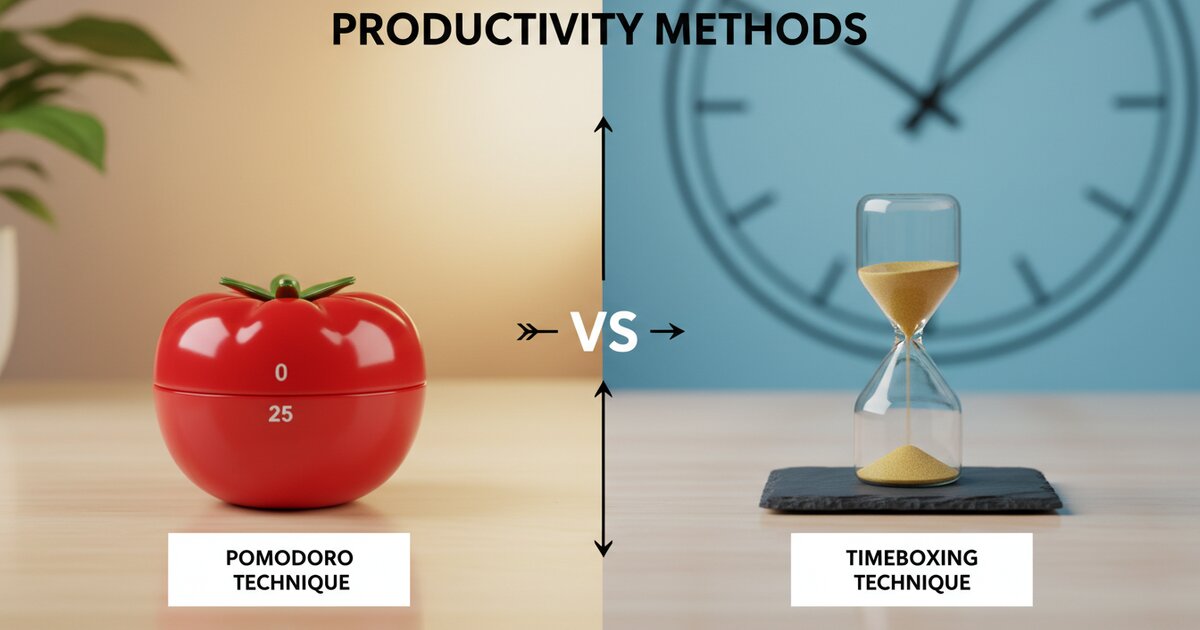
If you have spent any time reading about productivity, you have probably come across two methods that keep showing up: the Pomodoro Technique and timeboxing. Both use time constraints to help you focus. Both can make a real difference in how much you get done. But they approach the problem from very different angles, and the one that works better for you depends on what kind of work you do, how you think, and what your biggest productivity challenges actually are.
This article breaks down both methods side by side - how they work, where each one shines, and how to decide which one to try first. You might even find that the best answer is using both together.
Quick Overview of the Pomodoro Technique
The Pomodoro Technique is a time management method created by Francesco Cirillo in the late 1980s. The structure is simple and rigid by design: you work for 25 minutes, then take a 5-minute break. That is one "pomodoro." After completing four pomodoros, you take a longer break of 15 to 30 minutes. Then you start the cycle over again.
The intervals are fixed. You do not adjust the 25-minute window based on the task. If the task takes more than one pomodoro, you keep going across multiple cycles. If you finish early, you use the remaining time to review your work or start something small. The 25-minute duration is intentionally short enough that starting feels easy but long enough to make real progress.
The key principles are:
- Work with full focus during each 25-minute interval - no email, no phone, no switching tasks
- Take every break, even if you feel like you are in the zone
- Track how many pomodoros each task takes so you can estimate better over time
- If an interruption comes up, write it down and deal with it later
The method gives you a strict rhythm. You do not have to decide how long to work or when to take a break. The system decides for you, and that is a big part of why it works - it removes the negotiation you normally have with yourself about whether to keep working or take a break.
Quick Overview of Timeboxing
Timeboxing is the practice of assigning a fixed amount of time to a specific task or activity before you start working on it. Unlike the Pomodoro Technique, the duration is flexible - you choose how long each timebox should be based on the task. A timebox might be 30 minutes for catching up on email, 90 minutes for writing a report, or 2 hours for a design session.
The core rule is that when the timebox ends, you stop. Even if the task is not finished, you move on to whatever is scheduled next. This hard stop is what separates timeboxing from simply making a to-do list. It forces you to work within constraints and prevents any single task from eating your entire day. This is Parkinson's Law in action — without a time boundary, work naturally expands to fill whatever time you give it.
Timeboxing is closely tied to calendar planning. Most people who use it put their timeboxes directly on their calendar, filling the day with specific blocks for specific tasks. This means your calendar becomes your to-do list - if something is not on the calendar, it does not get worked on that day.
The method is popular in project management, software development (where it is part of agile and scrum methodologies), and among executives who need to juggle many different responsibilities across a single day.
Key Differences
On the surface, the Pomodoro Technique and timeboxing look similar - both involve setting a timer and working within a fixed period. But the differences matter quite a bit in practice.
Interval length. Pomodoro uses a fixed 25-minute interval for all tasks. Timeboxing lets you set any duration you want - 20 minutes, 45 minutes, 2 hours, whatever fits the task. This makes timeboxing more flexible but also means you have to make more decisions about how long each block should be.
Break structure. The Pomodoro Technique has mandatory breaks built in - 5 minutes after each work session, a longer break after four sessions. Timeboxing has no built-in break policy. You can schedule breaks between your timeboxes, but nothing in the method requires it. Some people using timeboxing stack blocks back to back and burn out by mid-afternoon because they forgot to rest.
Task assignment. In timeboxing, each block is typically assigned to a specific task or project. Your 10am to 11:30am block is for writing the quarterly report. Your 1pm to 2pm block is for reviewing pull requests. With Pomodoro, you can work on whatever you need to during each 25-minute sprint - the method is about the rhythm, not about pre-assigning tasks to specific times.
Planning approach. Timeboxing is a top-down planning method. You look at your day, decide what needs to get done, estimate how long each thing will take, and fill your calendar accordingly. Pomodoro is more bottom-up - you pick a task, start the timer, and work. You can plan which tasks to tackle in what order, but the method itself does not require a full-day plan.
Flexibility. Timeboxing gives you more control over duration but less structure around breaks and rhythm. Pomodoro gives you less control over duration but provides a built-in work-rest cycle that keeps you sustainable throughout the day. The trade-off comes down to whether you need more flexibility in how long you work on things, or more structure in how you manage your energy.
When the Pomodoro Technique Works Best
The Pomodoro Technique is strongest when you need external structure to get started and stay on track. If your biggest problem is not a lack of time but a lack of focus, Pomodoro is probably the better fit.
Fighting procrastination. One of the best things about the Pomodoro Technique is that it makes starting easy. Committing to 25 minutes of work is far less intimidating than committing to "work on this until it is done." If you struggle with procrastination, the short intervals give you a low-friction way to begin. And once you start, momentum usually carries you through multiple pomodoros.
Studying and learning. Students consistently report that Pomodoro is one of the most effective study methods. The regular breaks prevent mental fatigue, and the timed sessions create a sense of urgency that keeps you engaged with the material. It is much harder to zone out or passively re-read the same page when a timer is running.
Repetitive or administrative tasks. Data entry, email processing, grading, filing - these tasks are tedious, and without a timer they tend to stretch out way longer than they should. Pomodoro keeps you moving through them at a steady pace. Knowing a break is coming in 15 minutes makes boring work more tolerable.
When you need built-in breaks. If you are the kind of person who sits down at 9am and looks up at 1pm realizing you have not moved, eaten, or had a glass of water, Pomodoro forces you to pause regularly. Those breaks are not optional - they are part of the system. And they are critical for sustaining your performance across the full day.
When focus is hard to maintain. If you find your attention span drifting constantly, the fixed 25-minute window gives your brain a manageable target. You do not have to focus for two hours. You just have to focus for 25 minutes. Most people can do that, even on a bad day.
When Timeboxing Works Best
Timeboxing shines when you need to manage a diverse set of tasks across your day and want full control over how much time each one gets. It is less about building focus habits and more about allocating your time strategically.
Creative work that needs longer sessions. Writing, designing, coding, composing - these tasks often need more than 25 minutes before you hit your stride. A 90-minute or 2-hour timebox gives you room to warm up, get into a flow state, and produce meaningful output without being interrupted by a break timer. Some creative workers find that the Pomodoro break at 25 minutes actually disrupts their flow just as they are getting into it.
Meetings and collaborative work. Meetings have a natural duration. A 30-minute standup, a 60-minute planning session, a 45-minute one-on-one - these do not fit neatly into 25-minute blocks. Timeboxing lets you assign the right amount of time to each meeting and ensures they do not run over. This is actually one of the original use cases for timeboxing in project management.
Project planning and estimation. When you have a list of 8 different tasks that all need to get done today, timeboxing forces you to estimate how long each one will take and fit them into your available hours. This planning process itself is valuable. It makes you confront whether your to-do list is realistic, and it forces you to prioritize because you cannot fit everything into a finite day.
Tasks that need variable time. Some tasks genuinely need 15 minutes. Others need 3 hours. Timeboxing accommodates this naturally. You do not have to figure out how many pomodoros something will take or awkwardly split a 40-minute task across two 25-minute blocks. You just set the timebox to 40 minutes and go.
When you want calendar-level planning. If you work best with a clear, visual plan for your entire day, timeboxing gives you that. Your calendar shows exactly what you are doing and when, with no gaps or ambiguity. For people who feel anxious about unstructured time or who juggle many responsibilities, this level of planning can be a huge relief.
Can You Use Both Together?
Yes, and this is actually the approach that many productive people settle on after experimenting with each method individually. The combination is straightforward: use timeboxing to plan your day, and use the Pomodoro Technique within each timebox to maintain focus.
Here is what a hybrid day might look like:
- 8:00 - 8:30 (timebox: email) - Process your inbox. Run one 25-minute pomodoro and use the last 5 minutes as your break before the next block.
- 8:30 - 10:30 (timebox: deep work on project) - This is your main creative or analytical work. Run four 25-minute pomodoros with 5-minute breaks in between. The timebox tells you what to work on. The pomodoros keep you focused and rested.
- 10:30 - 11:30 (timebox: meetings) - Two 30-minute meetings back to back. No pomodoros here - meetings have their own structure.
- 11:30 - 12:00 (timebox: code review) - One pomodoro of focused review work.
- 12:00 - 1:00 (timebox: lunch and recharge) - Step away from the screen completely.
- 1:00 - 2:30 (timebox: writing) - Three pomodoros of focused writing. The timebox prevents you from spending all afternoon on this one task.
- 2:30 - 3:00 (timebox: admin tasks) - One pomodoro to knock out scheduling, expense reports, or other small items.
- 3:00 - 3:30 (timebox: email) - Second email check of the day. One pomodoro to process and respond.
- 3:30 - 4:30 (timebox: project work) - Two pomodoros for your secondary project or lower-priority deep work.
- 4:30 - 5:00 (timebox: planning) - Review what you accomplished today and set up tomorrow's timeboxes.
The beauty of this combination is that timeboxing handles the "what" and "when" while Pomodoro handles the "how." Timeboxing prevents you from spending too much time on any single area. Pomodoro prevents you from losing focus within each block. And the mandatory breaks keep your energy from crashing in the afternoon.
Not every timebox needs pomodoros inside it. Meetings, phone calls, and very short blocks (under 30 minutes) often work fine on their own. But for any timebox where you are doing solo focused work - writing, coding, studying, analyzing - adding the pomodoro rhythm inside it tends to make you both more productive and less tired.
Which One Should You Try First?
If you are not sure where to start, here is a simple framework to help you decide.
Start with Pomodoro if:
- You struggle with procrastination or getting started on tasks
- You often lose track of time and forget to take breaks
- You want a system that requires almost zero setup - just pick a task and start the timer
- Your biggest challenge is maintaining focus, not deciding what to work on
- You are new to productivity methods and want something simple to begin with
Start with timeboxing if:
- You have many different tasks competing for your time each day
- You already have decent focus but struggle with prioritization and planning
- Your work involves a mix of meetings, collaborative time, and solo work
- You do creative work that benefits from longer uninterrupted sessions
- You want a full picture of how your day is structured before it starts
Neither method is universally better than the other. They solve different problems. The Pomodoro Technique is fundamentally a focus and energy management tool - it helps you work better within whatever time you have. Timeboxing is fundamentally a planning and allocation tool - it helps you decide how to distribute your time across competing demands.
If both lists resonate with you, that is a good sign that the hybrid approach described above will work well. Start with whichever method addresses your most pressing problem, get comfortable with it over a week or two, and then layer in the other one.
Conclusion
The Pomodoro Technique and timeboxing are both effective ways to use time constraints to get more done. They are not competing methods - they are complementary tools that address different aspects of productivity. Pomodoro gives you rhythm, focus, and built-in recovery. Timeboxing gives you structure, planning, and control over your day.
The worst approach is doing neither and letting your day happen to you. Reactive work - constantly responding to whatever feels most urgent, checking email every few minutes, attending meetings without a plan for the rest of your time - is how people end up busy all day with nothing to show for it.
So pick one and try it this week. If you want to start simple, open Productivity Timer, set the timer for 25 minutes, and work on the most important thing on your list. That is all it takes to begin. You can refine your system later. The first step is just putting a boundary around your time and working within it.
Frequently Asked Questions
What's the main difference between Pomodoro and timeboxing?
The Pomodoro Technique uses a fixed 25-minute work interval with mandatory breaks built in. Timeboxing lets you choose any duration for each task and does not include a built-in break schedule. Pomodoro focuses on rhythm and sustained focus, while timeboxing focuses on planning and allocating your day.
Can you combine Pomodoro and timeboxing?
Yes, and many people find the combination works well. You use timeboxing to plan your day and assign blocks to specific tasks, then run Pomodoro cycles inside each block to stay focused and take regular breaks. Timeboxing handles the what and when, while Pomodoro handles the how.
Which is better for creative work?
Timeboxing is often a better fit for creative work because it lets you set longer sessions of 60 to 90 minutes or more. Creative tasks like writing, designing, and coding frequently need a warm-up period before you hit your stride, and the Pomodoro break at 25 minutes can interrupt that flow just as it gets going.
Is timeboxing more flexible than Pomodoro?
Timeboxing gives you more flexibility in how long you work on each task, since you set the duration yourself. However, it offers less structure around breaks and pacing. Pomodoro is more rigid in timing but provides a built-in work-rest cycle that keeps your energy steady throughout the day.